Jewelry from the Mycenae Chamber Tombs
14th-13th century BC

Safety Pins and jewelry have not changed much in over 3,000 years!


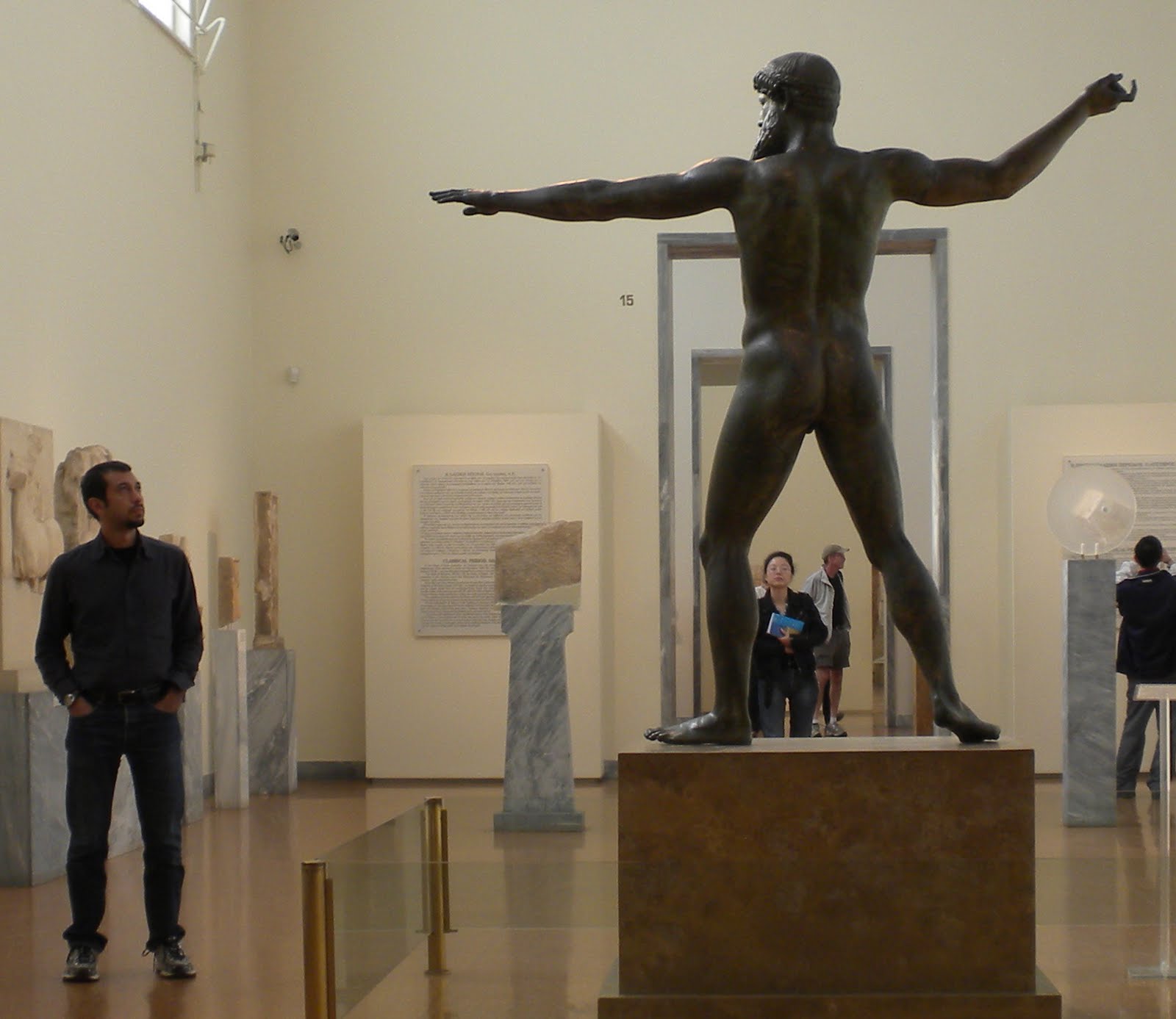
 This two meter high bronze statue of Zeus or Poseidon dates from about 460 BC and was found in 1928 at the bottom of the sea north of the Greek island of Euboea. The god is throwing either a thunderbolt or a trident, giving reason for the debate about who is depicted in the sculpture.



 Found in 1990 in an ancient shipwreck on the sea floor off Antikythera, south of Peloponnese, this Bronze statue of a youth (340-330 BC) has been identified either as Perseus, who would have been holding the head of Medusa, or, more probably, as Paris, with the “apple of Strife”, ready to award it to the most beautiful goddess, Aphrodite.

 One of the first displays that a visitor sees at the National Archeological Museum are kouri.
 The kouri are statues of naked youth that were made starting in the second half of the 7th century BC. These heroic statues, usually with the left leg forward and arms at the side, were often found at sacred sites as offerings to the gods and were found on graves as memorials of the dead, recalling the person’s past youthfulness of power.


 On the first of numerous strolls through the neighborhood of Plaka we found a small shop with religious items.
  The owner, Anastasios Vobirakis, spoke English and, in addition to sharing his merchandise, he shared many stories about his Christian faith. We wanted to return to the shop to obtain an icon, but it took us the rest of the week to find the store again. It was not until our last night in Athens that we spotted it, but the shop was already closed.
 We just returned from Athens where Vincenzo ran in the Athens Classic Marathon. It was his second full marathon race, and his time was 10 minutes better than his Rome Marathon in March, 2010.


 When you stop in at McDonald's in Rome for something to eat, part of the menu will seem familiar to Americans. You can see a picture of CBO, a sandwich with pollo, bacon and cipolla (in the US that's cheese-bacon-onion) next to the McFlurry options.


 On Sunday I journeyed with three friends to St. Peter's Square to witness the canonization of six saints, including Mary Mackillop, Australia's first saint.


 Tens of thousands of people gathered in St. Peter's Square for the canonization Mass. (In addition to Mary Mackillop (1842-1909), Pope Benedict XVI also canonized the French Canadian Andre Bessette (1845-1937), Stanislaw Soltys (1433-1489) from Poland, Juana Cipitria Barriola (1845-1912) of Spain, and two Italians, Giulia Salzano (1846-1929) and Camilla Battista Varano (1458-1524).
 St. Peter's Square was literally a sea of people. We we in front of a group from Scotland, beaming because of the Scottish heritage of Mary Mackillop, and behind a group of Australians of Lebanese descent.
 This cross contains a relic of Mary Mackillop and was presented to the pope during the canonization. (It was at Caravita a couple of weeks earlier, pictured here with Sister Maria Casey, a member of Mackillop's religious order who was the procurator for Mary Macillop's cause for sainthood, and Tim Fischer, the Austalian Ambassador to the Holy See.