
 On New Year's Day we drove almost four hours northeast of Rome to the town of Urbino in the Marche region. The Tom-Tom GPS guided us along the Via Flaminia, the route chosen in 220 BC by the Roman politician and consul Flaminius to be one of the most important roadways of ancient Rome, connecting the capital to the Adriatic Sea.
 It was dark when we arrived in Urbino, after driving through rain and fog in the mountains. We parked our car outside the old city and walked through the Porta Lavagine up to Via Raffaello.
  This building housed our bed and breakfast and was just down the street from the birthplace of Raffaello.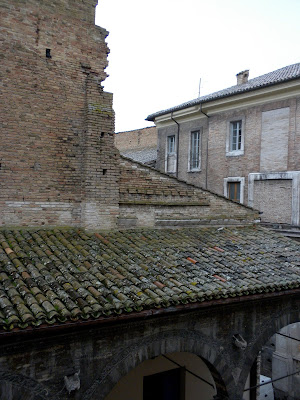
This is the roof of the Church of San Francisco,
outside our B&B window.


Here are men hanging out in Piazza della Repubblica on Sunday Morning.

 The Ducal Palace of Federico di Montefalcro, designed by Luciano Laurana, holds many treasures. One of the rooms is a studiolo, a small room for study and contemplation with walls of trompe-l'oeil wooden inlays, depicting shelves, benches and half-opened cabinets. The palace also houses the National Gallery of the Marche with an amazing collection of Renaissance art.
 San Crescentino is the patron of Urbino. (I confused him with St. George when I first saw this statue. They are both legendary slayers of dragons.) Crescentino was a Roman soldier who converted to Christianity, and was beheaded during the persecution of Diocletian in 303 AD.

A statue of a bishop stands guard outside the Duomo.
 The Ducal Palace of Federico di Montefalcro, designed by Luciano Laurana, holds many treasures. One of the rooms is a studiolo, a small room for study and contemplation with walls of trompe-l'oeil wooden inlays, depicting shelves, benches and half-opened cabinets. The palace also houses the National Gallery of the Marche with an amazing collection of Renaissance art.
 San Crescentino is the patron of Urbino. (I confused him with St. George when I first saw this statue. They are both legendary slayers of dragons.) Crescentino was a Roman soldier who converted to Christianity, and was beheaded during the persecution of Diocletian in 303 AD.


